


College Football Sim 2
3.465.00 Reviews
App Specs
- Version
- 1.1.7
- Updated On
- License
- Free
- Downloads
- 10,000+
- Developer
- Alec Jaco
- Categories
- Sports
- Platform
- Android
Screenshots
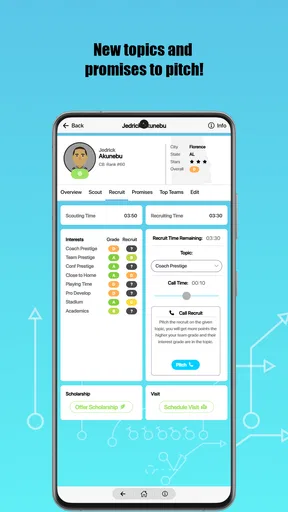
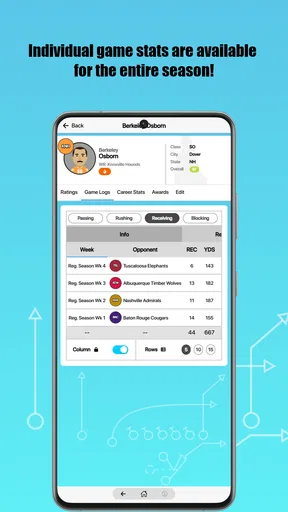
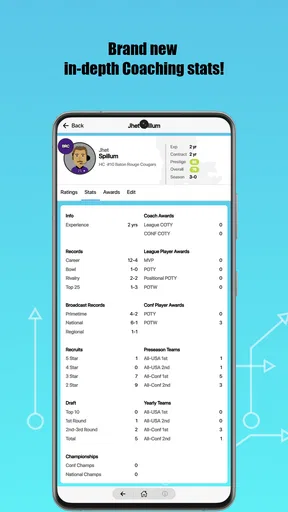
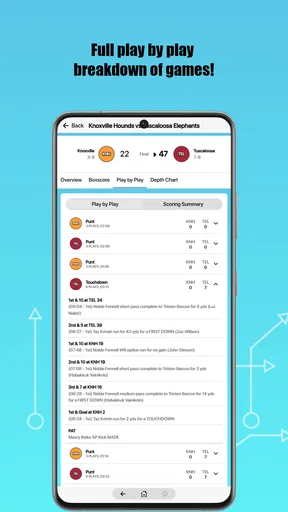
 Analysis by AppCompare
I went into College Football Sim 2 expecting a compact sports-management game, and that is the right way to approach it. This is not a fast match-day action title where you control every play. It is a college football simulation built around the appeal of shaping a program over time, making decisions, and seeing whether a team can grow into a lasting dynasty. The central question is simple, but it gives the game a clear identity: can I turn an ordinary college team into one that consistently competes?
Developed by Alec Jaco, the game is free to download and sits in the sports category. It has an Everyone age rating, which makes it easy to recommend to younger players and to people who prefer strategy without mature themes. The current version is 1.1.7, and it runs on Android devices using version 5.1 or later. Its store summary asks whether you have what it takes to build a college football dynasty, and after spending time with it, I think that question describes the intended experience better than any promise of flashy presentation would.
My overall impression is mixed in a useful way. The game has a focused idea and can be satisfying when I want a slower, more thoughtful sports experience. At the same time, its appeal depends heavily on whether I enjoy imagining the story of a program rather than needing constant visual action. If you are looking for a quick arcade football game, this will probably feel too indirect. If you like planning, setbacks, and gradual improvement, it has a more interesting chance of holding your attention.
How the early goals shape the first sessions
The opening appeal comes from having a recognizable long-term ambition instead of treating every session as an isolated match. I am not simply trying to win a single contest and then move on. I am thinking about the condition of the whole program and whether my choices are moving it toward a stronger future. That gives early decisions more weight than they would have in a purely pick-up-and-play sports game.
What makes the beginning work is the size of the goal. Building a dynasty sounds ambitious, but it can be approached through smaller personal targets: become competitive, avoid wasting a season, improve the team’s position, and create a foundation that can support better results later. I found that this kind of layered objective is more motivating than a game that immediately hands me a powerful team and removes the need to think.
The early stage is also where I learned to avoid judging progress after one result. A single win can feel exciting, but it does not automatically prove that the program is healthy. Likewise, a poor result does not necessarily mean that every decision was wrong. The more useful question is whether the overall direction makes sense. That mindset is important because simulation games can feel unfair if I expect instant rewards for every choice.
My practical advice is to set a short-term objective before starting a session. I might focus on stabilizing results, testing a new approach, or simply learning how the game presents its information. Without that small target, the experience can become a sequence of menus and outcomes. With one, even a quiet session has a purpose. This is one of the game’s less obvious strengths: it rewards the player who supplies a little structure instead of waiting for the game to provide all the excitement.
Worth Reading Before You Choose

EA SPORTS FC Mobile 26 Is a Bigger Football Game, but It Takes Time

Flipboard Shows What News Apps Must Do Beyond the Feed

Switching to Android Auto Means Rethinking Your Driving Routine

Google Calendar Makes a Crowded Week Easier to Manage

Ludo King Makes the Most of the Minutes Between Plans

Baby Panda World Brings Quick Play to Modern Phones, but Its Game Library Feels Busy
The early goals are less suitable for someone who wants immediate control. There is no reason to choose this title if your favorite part of football games is manually throwing, tackling, or directing every possession. The satisfaction here comes from being responsible for a program rather than acting as the player on the field. I would describe it as a planning game wearing college football clothing, not as a conventional football game with a management option attached.
What counts as progress when the game is quiet
One of the most important things to understand is that progress is not only a dramatic winning streak. In a simulation, improvement can be easier to notice through patterns: a team becomes more reliable, a difficult stretch is handled better, or a decision that once felt risky starts producing more stable outcomes. I paid more attention to these signals than to any single headline result, because they helped me understand whether my approach was actually working.
This creates a different rhythm from the usual sports alternatives. In an action game, progress is obvious because my own skill is visible in every play. Here, the feedback is more indirect. I have to connect decisions with outcomes and accept that the relationship may not be immediate. That can feel rewarding when I recognize a long-term improvement, but it also means the game asks for patience.
A useful workflow is to pause after an important stretch and ask three questions: what was I trying to improve, what actually changed, and what should I stop doing? This sounds simple, but it prevents the common mistake of changing everything after a disappointing result. If I alter several parts of my approach at once, I lose the ability to tell which decision mattered. Making one meaningful adjustment at a time turns the game into a clearer experiment.
That approach also helps with the game’s pacing. When progress is slow, the temptation is to chase a big change just to feel active. I found that restraint was often more useful. A modest improvement that can be repeated is more valuable than a dramatic decision that produces one exciting result and then leaves the program unstable. The game does not need to shout every improvement for a careful player to find a sense of advancement.
Players who need a detailed progression map may find this less satisfying than a larger sports-management game. Bigger alternatives often surround the player with extensive statistics, presentation, and explicit milestones. College Football Sim 2 is more appealing when I am comfortable reading the situation and creating my own interpretation of what success looks like. That makes it approachable, but it can also make the experience feel less guided.
The challenge curve rewards patience more than speed
The challenge is not simply about whether I can make one clever decision. It comes from maintaining a sensible direction while results fluctuate. A strong outcome can encourage overconfidence, while a bad one can make me abandon a plan too quickly. The game’s tension comes from managing that emotional swing as much as from finding the perfect move.
I think this is where the college setting helps. A dynasty is naturally a long-term idea, so the player is encouraged to think beyond immediate success. Even when the current situation is not ideal, the possibility of building something better gives the setback a purpose. That is more compelling than a ladder of disconnected matches because the results feel like part of a continuing story.
Still, the challenge curve may feel uneven depending on what kind of feedback a player expects. Someone who wants clear explanations for every outcome could become frustrated. Simulation results are often easier to accept when I treat them as information rather than judgment. A loss tells me that the current plan did not produce the result I wanted; it does not necessarily identify one obvious mistake for me.
I recommend approaching difficult periods with a review rather than a reset mentality. Look at the broader run, identify the decision that most needs attention, and give the next attempt enough time to reveal whether the adjustment helped. This is a concrete way to make the challenge feel fairer. It also protects the game from becoming a cycle of random changes made in response to the latest result.
Compared with a typical arcade football game, the difficulty is less about reflexes and more about consistency. Compared with a large, detailed management simulator, it is easier to enter but may not offer the same depth for players who want every layer represented. I see that as the central trade-off. The game can be a good middle ground for someone curious about college football management, but a specialist may eventually want a more elaborate alternative.
What keeps the dynasty idea moving
The game’s retention comes from the desire to see what happens next. Once I become invested in a program, an ordinary result gains context. I am not only asking whether the latest outcome was good; I am asking whether it changes the direction of the team. That continuing question is the strongest reason to return.
However, the same structure can create retention pressure. A long-term goal can be motivating, but it can also make a session feel like work if I am not in the mood for careful decisions. There are moments when I wanted a faster payoff, especially after spending time thinking through a plan and receiving an outcome that did not immediately clarify what to do next. This is not a flaw unique to this game, but it is important to understand before downloading it.
The free price makes experimentation easy, although in-app purchases cost $2.99 per item. I would treat those purchases cautiously and decide first whether the basic loop is enjoyable without them. The free entry point is valuable because this is a niche style of sports game; I would rather test the management rhythm myself than assume it will suit me based on the football theme alone.
Its audience size also gives some context. The game has passed ten thousand installs, with an average rating of 3.4 from roughly a hundred and forty-five ratings and sixty-five written reviews. I would not treat that rating as a final verdict, but it does suggest that the experience is more specialized than universally appealing. My own reaction fits that picture: the concept is clear, but the slower simulation format will divide players.
A realistic everyday use case is a short evening session after work or school. I can open the game, review where my program stands, make one or two deliberate decisions, and stop without needing to commit to a full action-heavy match. That makes it suitable for a player who enjoys checking a developing project in small bursts. It is less suitable for someone who wants a complete burst of excitement in five minutes, because the satisfaction often comes from connecting several sessions together.
Who should choose it and who should skip it
I would recommend this game to fans of college football who enjoy the idea of responsibility more than spectacle. It is also a reasonable choice for someone trying management-style sports games for the first time and wanting a focused concept rather than an enormous system to learn. The dynasty framing gives each decision a reason to exist, and the free download lowers the barrier to finding out whether that style fits.
I would skip it if I want licensed broadcast presentation, direct athlete control, elaborate graphics, or the instant feedback of an arcade match. I would also look elsewhere if my enjoyment depends on seeing a clearly labeled reward after every action. This game asks me to create meaning from the program’s longer arc, and that is not the same as receiving constant progression signals.
It is worth remembering that the Everyone rating describes the game as broadly accessible, not necessarily universally engaging. Younger players can understand the sports premise, but the most rewarding part may still require patience and an interest in planning. Adults who do not follow college football may enjoy the management idea, yet the theme will naturally be more appealing if the idea of building a college program already interests them.
The minimum operating requirement is Android 5.1, so the game is available to people using older compatible devices. That is helpful for accessibility, but device compatibility alone does not determine whether the experience will feel good. The more important question is whether I enjoy a simulation where the story develops through decisions and outcomes instead of direct control.
My verdict on goals, pacing, and long-term appeal
After playing it as a management-focused sports title, I see College Football Sim 2 as a modest but distinctive option. Its best quality is the way it turns college football into a long-term project. I can set a direction, watch the program respond, and learn to value steady improvement instead of chasing one spectacular result. That makes the dynasty idea more than a decorative phrase; it is the reason the game can hold my attention.
Its main weakness is the same feature viewed from another angle. The pace is deliberate, and the feedback can require interpretation. Players who want a highly explained progression system or constant action may find the experience thin. I also think the game would be easier to recommend without reservation if every setback communicated its lesson more clearly, because uncertainty can make a simulation feel less satisfying even when the underlying idea is sound.
My final recommendation is to try it if you want a free college football simulation that fits short, thoughtful sessions and you are willing to judge progress over time. Start with a small goal, change one part of your approach at a time, and do not let one result define the whole program. Those habits make the pacing work much better. If you want to control the action on the field or prefer a larger, more detailed management package, choose a different sports game instead.
For the right player, the appeal is not a flashy unlock or an endless stream of rewards. It is the quiet satisfaction of seeing a struggling program become more coherent because of the choices I made. This is a game for building a football story patiently, not consuming one instantly. That limits its audience, but it also gives the title a clear personality that many faster sports games never develop.
Pros
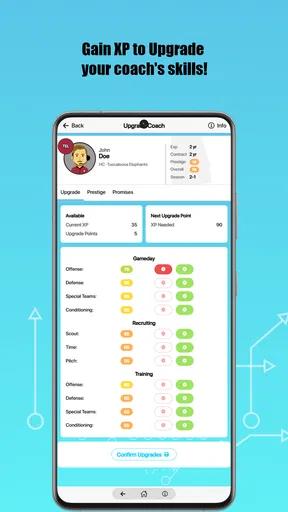
- Deep team and season management for college football fans.
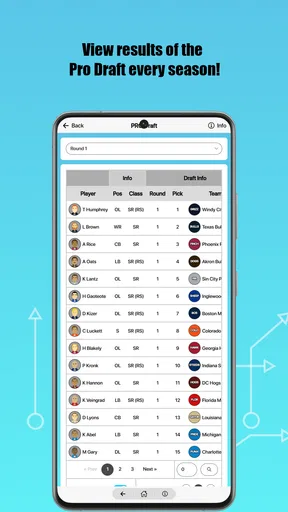
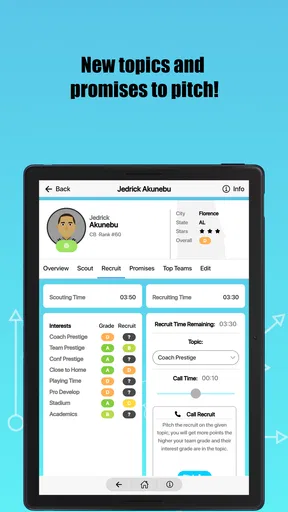
- Detailed recruiting system adds long-term strategic depth.
- Games run quickly
- making it easy to play through seasons.
- Offers plenty of customization for teams
- conferences
- and schedules.
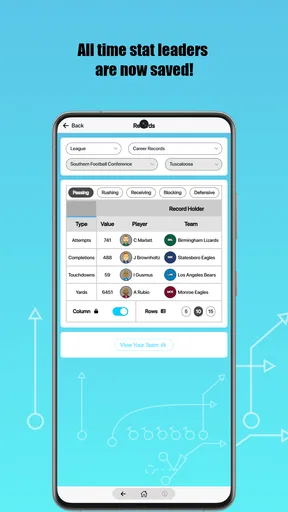
- Works well for players who enjoy statistics and text-based simulations.
Cons
- The interface feels dated and may take time to understand.
- There is no live-action gameplay or visual match presentation.
- New players may find the many management options overwhelming.
- Some seasons can become repetitive after several playthroughs.
- The experience is better suited to niche sports sim fans than casual players.
FAQs for College Football Sim 2
What is College Football Sim 2?
College Football Sim 2 is a college football management and simulation game focused on strategy rather than direct, arcade-style control. You typically take responsibility for building and guiding a program, making decisions about recruiting, team development, schedules, tactics, and performance. The appeal comes from planning a season, managing long-term progress, and seeing how your choices affect results over time.
How does the gameplay work in College Football Sim 2?
The game is primarily designed around making managerial and coaching decisions before and during a simulated college football season. Instead of controlling every player manually, you evaluate your roster, set strategies, manage resources, and respond to team performance. Each season can feel different because recruiting outcomes, player development, opponents, and strategic choices all influence the final results.
Is College Football Sim 2 suitable for beginners?
College Football Sim 2 can be enjoyed by beginners, especially players who like sports management games and do not need constant action. However, new users may need time to understand the menus, statistics, recruiting systems, and the effect of different decisions. It is best approached patiently, since the most rewarding results usually come from learning the systems and planning beyond a single game.
Does College Football Sim 2 require an internet connection?
The core experience is generally intended to be a single-player simulation, so many of its management features may be available without a continuous internet connection. Nevertheless, connection requirements can vary depending on the platform version and any online services, updates, advertisements, or account features. Check the current store listing before downloading if offline access is especially important to you.
Is College Football Sim 2 free to download?
The availability and pricing of College Football Sim 2 can depend on whether you are using Android or iOS, as well as the version currently offered in the relevant app store. Before installing, review the listing for the download price, advertisements, optional purchases, and any subscription-related information. This is particularly useful for players who want to understand the complete cost before starting a long-term career.


